
Green Room Setup for Talent
Green Room Setup for Talent
A green room setup for talent is a dedicated backstage or near-stage space designed for performer holding, preparation, recovery, and hospitality before, during, and after an event. It is not simply a lounge or dressing room; it functions as controlled infrastructure that supports everything from vocal warm-ups to wardrobe checks to pre-show decompression.
This guide covers essential room elements and technical standards, personalization for different performer types, common setup mistakes and security protocols, location-specific planning for Coconut Grove waterfront venues, and how Bayshore Club's documented event services connect to talent hospitality.
Comfortable seating, food service, tech amenities, and lighting form the foundation of any functional green room. Mixed furniture supports both relaxation and focused work, while a hospitality rider documents who supplies water, meals, allergen-labeled food, and cleanup responsibilities. Reliable power, Wi-Fi, a stage monitor feed, and makeup-accurate lighting round out the production-grade environment.
Musicians, speakers, and actors each carry distinct pre-performance demands. Instrument storage, vocal warm-up zones, presentation preview capability, and closed-access dressing provisions all require advance coordination through a written rider rather than day-of improvisation. Branding elements belong in shared zones, not inside a performer's private preparation space.
Privacy failures, blocked egress, unverified amenities, and missing stage management rank among the most common green room mistakes. Credential-based access, lockable storage, enforced no-photography policies, and a structured pre-arrival checklist prevent these breakdowns.
Coconut Grove's waterfront setting introduces heat index extremes, lightning protocols, hurricane contingency planning, and municipal permitting requirements that directly shape room placement and production timelines. Bayshore Club offers documented catering packages, private spaces, and dietary accommodations, though performer-specific details like dedicated green rooms or acoustic isolation require direct verification with the venue's event team.
What Key Elements Should a Green Room for Talent Include?
The key elements a green room for talent should include are comfortable seating, food and beverage service, technical amenities, and controlled lighting. The following subsections cover how to arrange each element.
How Should Seating and Comfort Be Arranged in a Green Room?
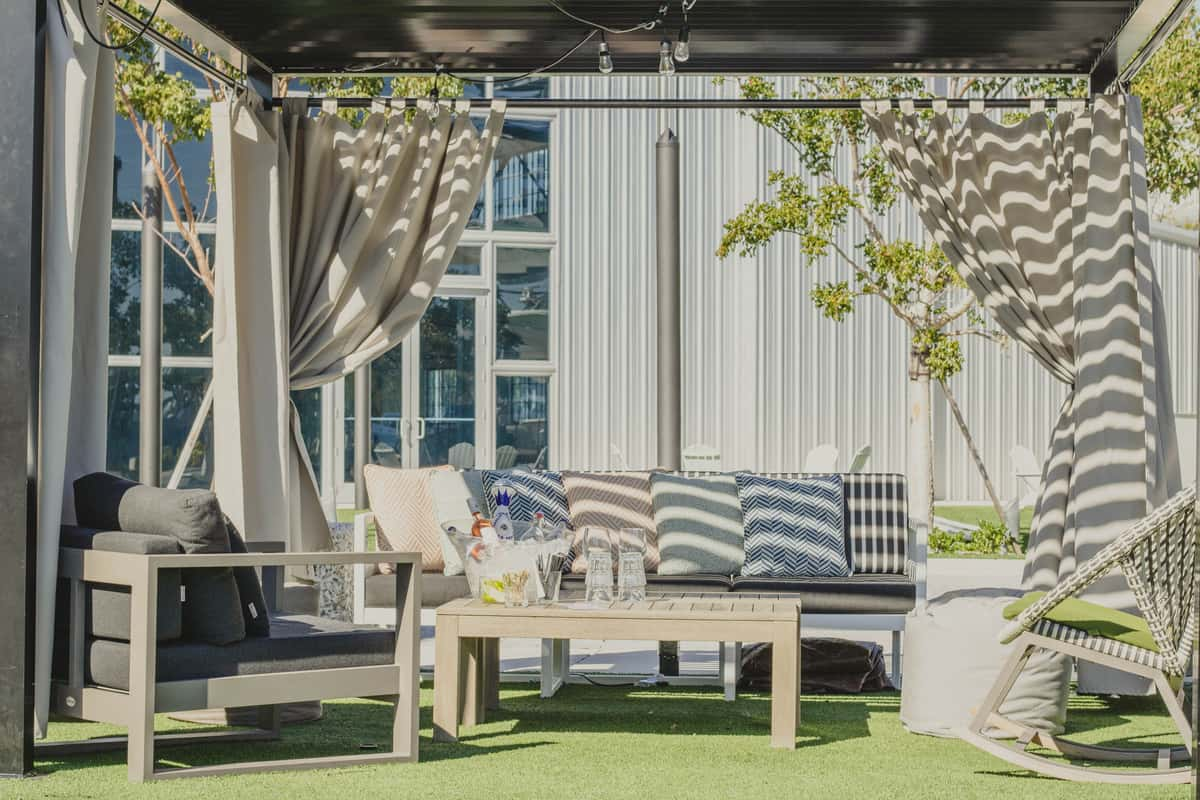
Seating and comfort in a green room should be arranged with mixed furniture types that support both relaxation and preparation. According to NC State University's University Theatre Spaces documentation, a standard green room contains "a sofa, table, chairs, and a small kitchenette" along with a full-length mirror. Combine upright chairs with lounge seating so talent can choose between focused work and rest. Include a dedicated work table, garment storage, and a nearby restroom. A dressing room, which provides private wardrobe and makeup space, may sit adjacent to but is not synonymous with the green room itself. Offering both a quiet zone and a social zone gives performers genuine control over their pre-show environment.
What Food and Beverage Options Are Ideal for Talent in the Green Room?
The ideal food and beverage options for talent in the green room are clearly labeled meals, consistent hydration, and a documented allergen process. A hospitality rider should specify who supplies water, coffee, ice, snacks, and meals, along with service timing and refrigeration. Key considerations include:
- Separating talent food service from guest traffic to maintain privacy and hygiene.
- Labeling all allergens and dietary meals with documented ingredients and cross-contact controls.
- Defaulting to nonalcoholic beverages unless the rider specifies otherwise.
- Designating a cleanable refreshment surface with bins for quick turnover.
- Confirming cleanup responsibilities between the caterer and production team.
Rectangular side tables work well for catered service, while a seated option at a round table accommodates small group meals. Never promise a specific diet or allergy control that has not been confirmed jointly by the venue and caterer.

What Audio, Video, and Tech Amenities Optimize Talent Preparation?
Audio, video, and tech amenities optimize talent preparation by providing reliable communication, monitoring, and power access within the green room. A production-grade setup should verify:
- Power outlets with confirmed load capacity for personal devices and equipment.
- Stable Wi-Fi and phone, intercom, or radio contact with the stage manager.
- A preview monitor or audio feed so talent can track the live program.
- Controlled audio bleed to keep the room usable for focus and conversation.
- Safe cable paths that do not block egress or create trip hazards.
Request the venue's equipment inventory and technical rider rather than inferring capabilities from event photography. For most talent, a single reliable monitor and a direct communication line to the production team matter far more than elaborate AV installations.
How Does Lighting and Ambiance Impact the Green Room Experience?
Lighting and ambiance impact the green room experience by shaping both preparation accuracy and psychological comfort. Makeup mirror lighting should closely match the color rendering of stage lighting so that wardrobe and cosmetic choices translate accurately under performance conditions. Beyond mirrors, the room needs safe circulation lighting without harsh glare, along with the option for dimmer settings in a low-stimulation quiet zone.
The evidence supports offering choice and control: predictable call times, a separate social area, reliable hydration, and consistent room conditions. However, a well-lit, comfortable room is supportive infrastructure, not a clinical intervention. Hospitality standards should be documented as a rider and operating checklist, with professional support signposting available where needed.
With these foundational elements defined, tailoring each detail to different performer types makes the setup truly effective.
How Can You Personalize a Green Room for Different Types of Talent?
You can personalize a green room for different types of talent by adapting comfort, technical amenities, and hospitality to each performer's specific demands. Musicians, speakers, and actors each require distinct preparation environments, and branding elements can be layered in thoughtfully.
What Special Considerations Exist for Musicians, Speakers, or Actors?
Special considerations for musicians, speakers, or actors center on the unique pre-performance demands each role carries.
- Musicians need hydration stations, secure instrument storage, power for equipment, ear protection, and a vocal warm-up zone. According to the University of Iowa Carver College of Medicine, Music Performance Anxiety is specifically triggered by musical performance demands, with severity fluctuating based on situational factors and manifesting before, during, or after a performance. A quiet, low-stimulation space helps manage these symptoms.
- Speakers require a private reset area with a table, chair, mirror, water, and presentation preview capability. A named stage manager and accessible route to the podium reduce last-minute friction.
- Actors need closed-access dressing provisions, a lighted makeup mirror, garment rack, and a nearby restroom with vocal-safe air quality.
Addressing these role-specific needs before the event, ideally through a hospitality rider, prevents reactive scrambling on show day.
How Can You Incorporate Branding or Theming Into a Green Room?
You can incorporate branding or theming into a green room through signage, digital displays, curated décor, and branded hospitality items placed in shared or transitional zones. Effective brand integration extends to invitations, event slides, media materials, and sponsored lounge areas outside the talent-only space.
The key distinction: keep sponsor activation separate from the performer's private preparation area unless talent and production explicitly consent. A corporate speaking program, for example, should maintain clear boundaries between executive hospitality, speaker preparation, sponsor visibility, and public guest flow. Placing branded water bottles or welcome cards inside the room works; surrounding a nervous performer with sponsor banners does not.
For events at a waterfront venue like Bayshore Club, theming that reflects the location's character creates a cohesive experience without overwhelming the room's functional purpose.
What Are Common Mistakes to Avoid When Setting Up a Talent Green Room?
Common mistakes when setting up a talent green room include treating an attractive lounge as a production-ready space, mixing public and talent traffic, and failing to assign a stage manager. The sections below cover privacy and security failures, plus steps to prevent last-minute shortcomings.
How Can You Ensure Privacy and Security in the Green Room?
You can ensure privacy and security in the green room by implementing credential-based access, lockable storage, and a strict no-photography rule. A talent-only entrance or zone prevents public foot traffic from crossing into preparation areas, which is one of the most frequently overlooked controls.
Key privacy and security measures include:
- Issuing credentials to everyone who enters the talent area, with no exceptions.
- Providing lockable storage for personal belongings, instruments, and valuables.
- Enforcing a camera policy that minimizes surveillance within the room and prohibits unauthorized photography.
- Assigning a privacy lead or escort responsible for controlling door access and visitor screening.
- Posting a staff contact list so talent can report concerns immediately.
For actors or hosts, closed access becomes especially critical; private changing provisions, a lighted mirror, a garment rack, and a nearby restroom should all sit within the credentialed zone. Even well-intentioned open-door policies erode the trust performers need to warm up, change wardrobe, or decompress without interruption.
What Steps Help Prevent Last-Minute Issues or Shortcomings?
Steps that help prevent last-minute issues or shortcomings start with a structured day-of walkthrough completed well before talent arrives. Testing every operational element under real conditions catches failures that planning documents miss.
A pre-arrival checklist should cover:
- Testing lights, power outlets, Wi-Fi, radios, and any stage monitor feed.
- Posting call times, emergency contacts, and evacuation routes visibly inside the room.
- Labeling dietary meals and stocking water before the first talent arrival.
- Clearing all egress paths of cases, furniture, or cable runs.
- Running a weather check, particularly critical for South Florida venues where, according to the Centers for Disease Control and Prevention, staying in an air-conditioned indoor location and drinking fluids are essential protective measures during extreme heat.
Never assume amenities work because they worked at the last event. A ten-minute equipment and safety sweep prevents the cascading problems that turn a minor oversight into a show-stop situation. Understanding these common pitfalls makes location-specific planning, especially for waterfront venues, far more effective.
How Does Location Affect Green Room Planning in Coconut Grove, FL?
Location affects green room planning in Coconut Grove, FL, through waterfront logistics, tropical weather exposure, and local permitting requirements. The subsections below cover venue-specific factors for waterfront sites and weather-driven design decisions.
What Local Factors or Logistics Must Be Considered for Waterfront Venues?
The local factors that must be considered for waterfront venues include heat index management, storm surge vulnerability, hurricane preparedness, and municipal event permitting. According to the Southeast Florida Regional Climate Change Compact, when air temperature reaches 88°F with 80% relative humidity, the heat index can feel like 106°F. That kind of exposure directly affects talent comfort and safety in any green room adjacent to outdoor staging areas.
Waterfront green room planning in Coconut Grove should address:
- Air-conditioned indoor refuge for performers before and after outdoor segments
- Storm surge awareness, since NOAA identifies surge as the leading cause of hurricane fatalities along the U.S. East and Gulf coasts
- Hurricane decision tree with backup communications and evacuation-zone review
- City of Miami special event permits, which cover tents up to 40x40 sq. ft., portable toilets, and generators up to 50KVA under a pilot affidavit program
Coconut Grove's Dinner Key waterfront is an extraordinary event setting, but production teams that treat the scenery as a substitute for operational planning put talent and crew at risk.
How Can Weather or Outdoor Elements Influence Green Room Design?
Weather and outdoor elements influence green room design by requiring enclosed, climate-controlled spaces with lightning protocols and heat mitigation built into every production timeline. The National Weather Service recommends that organizers of outdoor activities maintain a lightning safety plan and follow it without exception, stating there is no safe place outside when a thunderstorm is in the area.
For a Coconut Grove waterfront program, essential weather-responsive design elements include:
- Scheduling outdoor arrivals, photography, and sound checks around heat and storm triggers
- Moving all personnel to a substantial building at the first sign of lightning; a tent does not qualify as a lightning refuge
- Providing fluids and active heat monitoring inside the green room
- Ensuring ADA-compliant accessible routes between indoor and outdoor zones, as required by U.S. Access Board accessibility standards
Maintaining backup power and protected equipment storage completes the weather operations layer. With these protocols in place, planners can connect Coconut Grove's waterfront appeal to Bayshore Club's private event capabilities.
How Can Bayshore Club's Services Enhance a Green Room Setup for Talent?
Bayshore Club's services can enhance a green room setup for talent through documented catering packages, private and semi-private spaces, and a waterfront Coconut Grove setting suited to event hospitality. Below, we cover specific offerings and key takeaways.
Does Bayshore Club Offer Catering or Private Space Solutions for Talent Events?
Bayshore Club offers both catering and private space solutions relevant to talent events. According to the Greater Miami Convention & Visitors Bureau listing, Bayshore Club provides a 20-person private room, 50-person banquet capacity, 160 total seats, 250-person reception capacity, and full buyout availability.
Bayshore Club's published event packages include:
- Tray-passed experiences with three to seven item selections
- Food station experiences with customizable course counts
- A raw bar experience
- Nonalcoholic beverage packages in one-, two-, or three-hour formats
- Advance-notice dietary accommodations
Semi-private areas, a lounge, a dining room, and cabanas each support different group sizes and event styles. These documented spaces could serve as a talent holding or hospitality area when coordinated with production.
However, a dedicated green room, dressing room, makeup mirrors, wardrobe equipment, acoustic isolation, stage-adjacent route, or performer-only restroom is not publicly verified in reviewed non-blog materials. Any event planner should confirm these specifics directly with Bayshore Club's event team before building a green room plan around the venue.
What Are the Key Takeaways About Green Room Setup for Talent We Covered?
The key takeaways about green room setup for talent covered in this article center on function, safety, and verification. As the State University of New York at Fredonia notes, the green room is the place where performers gather before a performance, wait their turns, and relax when not on stage; virtually every theatre in the English-speaking world has a room with this name and purpose.
The most actionable lessons include:
- Define your green room by function: holding, preparation, recovery, and hospitality, not by decor or name alone.
- Confirm every amenity in writing with the venue; never assume capabilities from event photography or restaurant features.
- Separate talent traffic from public guest flow, and assign a named stage manager.
- Build weather contingency plans for any waterfront or outdoor Coconut Grove event.
- Match room personalization to talent type, whether musician, speaker, or actor.
Bayshore Club's documented catering, dietary accommodations, and private spaces provide a strong hospitality foundation. For a complete green room, verify performer-specific details directly with Bayshore Club's event contact before committing.